html-mocker: Batch Your AI Review Feedback Instead of Building a Live Loop
html-mocker lets a human point at an AI agent's output and leave notes; the interesting part is what it DOESN'T do. Three live-review designs, rejected in turn — the first two for the same cost fallacy (token cost is about what gets read, not which model reads it), the third for rebuilding a conversation you already have — so batch the notes and skip the UI entirely.
Every AI review loop I’d seen — including my first attempt at building one — makes the same expensive mistake: it treats every piece of human feedback as its own trip to the model. Leave a comment, the agent reacts immediately; leave another, it reacts again. It feels responsive. It also means cost scales with how many notes you leave, for no actual benefit, because the model needs the same full context on comment #1 as comment #20. Layer on a second failure — reaching for a cheaper model to “handle” the chatter, or building a whole chat UI just to relay it — and what looked like an obvious, conversational design splits into three separate wrong turns: two that overspend on the model, and one that rebuilds a conversation you already have — three costly answers to a problem that shouldn’t cost anything close to that much.
I hit this directly while building a small tool to let a human review an AI agent’s generated output: look at something the agent produced, point at specific parts of it, leave notes, have the agent act on them. The first instinct felt obviously right — live, conversational, react-as-you-go. Three designs later, “live” was gone entirely, and what replaced it was smaller than anything I’d tried to build.
Architecture: the review loop, from chat
The easiest way to see this is the same way you’d actually use it — starting from the same chat interface you use for everything else. Click through each step below.
And here is the whole loop actually running, end to end: on the left, the review panel docked in the browser with notes grouped by the exact element they point at; on the right, Claude Code reading that batch back and applying every fix in one pass. Every note in this shot is a real one I left while reviewing this very diagram (click the image to expand it):
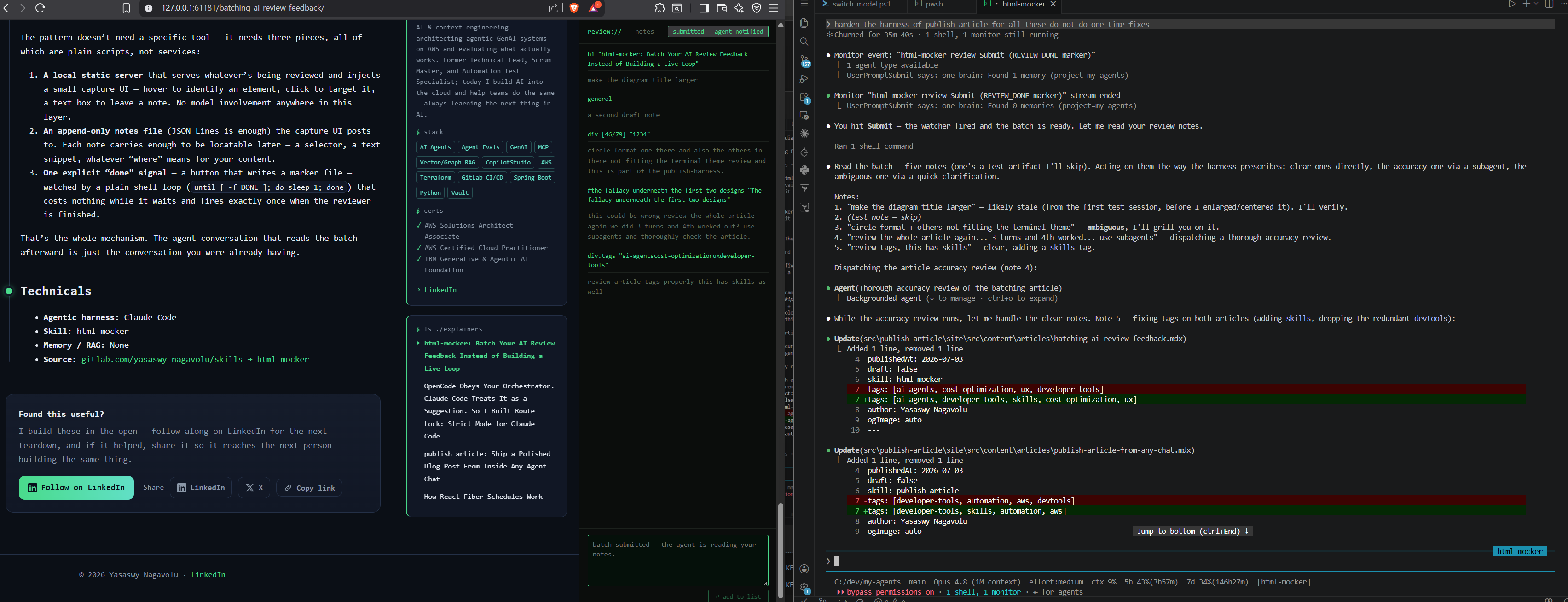
The panel makes the batching literal, not just conceptual: pressing Enter (or the button under the box) only drafts a note into the list — nothing is sent, no model is touched. You keep pointing and typing until you’re done, then one Submit hands the whole list over at once and locks it read-only. Drafting and submitting are two distinct phases on purpose: every note is free until the single paid read, so there’s no reason to spend one trip per comment.
One more thing the loop makes cheap: once the batch is in, an optional grill-me pass (a shout-out to Matt Pocock, whose grill-me skill this borrows) can interview you to sharpen any vague note before the agent acts — “which selector did you mean?”, “bigger how much?” — and because it’s just a skill, you can swap in your own (a linter, a design-token checker, whatever your team needs); the review surface is yours to customize.
The three designs that led here
Click through each below — what it looked like, the flaw that killed it, and what it led to.
Reviewer leaves a note, it's sent straight to the full-context model immediately, which reacts before the next note arrives.
Cost scales with comment count for no benefit — the model needs the same full context to act on comment #1 as comment #20, so paying for 20 separate invocations buys nothing over paying for one.
Stop reacting per-comment. Collect first, act once.
The fallacy underneath the first two designs
Both the “live round-trip” and “cheap model in front” designs share a hidden assumption: that cost is about which model is talking. It isn’t. Cost is almost entirely about how much gets read, and how many times.
A live design pays for a full-context read on every single comment, because the model doing the reacting needs the same context each time — the page, the prior notes, the goal — whether it’s comment #1 or comment #20. Batch the same notes into one read and you’ve paid for that context exactly once, no matter how many comments arrived.
The “insert a cheap model as a filter” design looks like it fixes this, and it’s the one I was most confident in before testing it against the actual failure mode. It doesn’t fix it, for two separate reasons:
- The cheap model lacks the context to do the filtering well. It doesn’t know what the reviewer actually cares about, what’s already been tried, or why a given note matters more than another — that context lives entirely in the conversation the expensive model has been having. Asking a context-free model to triage context-dependent notes just relocates the judgment call to somewhere worse.
- Reading a small, already-structured file is cheap regardless of which model reads it. If the captured notes are just data — a selector, a snippet of text, the comment itself — there’s no expensive “understanding” step to offload. The cheap model isn’t saving a costly operation; it’s inserting an extra hop in front of an operation that was already cheap.
The general shape of the mistake: a cheap model earns its cost only when it performs a real transformation the expensive model would otherwise pay full price for — deduping near-duplicates, dropping stale references, summarizing something genuinely large. If the data reaching the model is already small and structured, there’s nothing left for the cheap model to do except relay it, and relaying doesn’t need a model at all.
The second-order trap
The third design is the more interesting failure, because it wasn’t really about cost anymore — it was about building UI for a problem that already had a UI.
The instinct was: put a chat panel right where the reviewer is looking, so notes and replies happen in place instead of switching windows. It’s a reasonable UX instinct. It’s also solving a problem that doesn’t exist if the reviewer already has a perfectly good conversational surface open somewhere else — their actual conversation with the agent.
The tell was this: the injected chat panel could capture text, but it could never act. No tools, no ability to make the edit the reviewer was asking for. Which means the moment a note needed a real change, control had to pass back to the real agent conversation anyway. The custom panel wasn’t replacing that conversation — it was adding a second, worse copy of it in front of it.
The generalizable rule: before building a UI to relay information to or from an agent, check whether the agent already has a UI you’re about to duplicate. If it does, route through it. A capture surface that does nothing but capture — no reasoning, no chat, no model — and a single explicit Submit is enough to hand a full batch to the real conversation. Everything past that point is just the conversation you already had, continuing.
What survived
Nothing model-driven runs while the reviewer is working. Notes accumulate in plain storage with enough structure to be locatable later (what was pointed at, what was said) but no model reads them as they arrive. One explicit signal — the reviewer presses Submit — triggers exactly one read of the whole batch by the model that has full context. Anything ambiguous in that batch gets asked about in the same conversation, because that’s the cheapest possible way to ask: no new surface, no new model, no round-trip that didn’t already exist.
The lesson generalizes past this one tool: whenever a review or feedback loop touches an AI agent, ask two questions before writing any code. Does this really need to be live, or can it be batched and read once? And is there already a conversational surface I’m about to badly reimplement? Both questions are cheap to ask and expensive to skip.
Try it yourself
The pattern doesn’t need a specific tool — it needs three pieces, all of which are plain scripts, not services:
- A local static server that serves whatever’s being reviewed and injects a small capture UI — hover to identify an element, click to target it, a text box to leave a note. No model involvement anywhere in this layer.
- An append-only notes file (JSON Lines is enough) the capture UI posts to. Each note carries enough to be locatable later — a selector, a text snippet, whatever “where” means for your content.
- One explicit Submit signal — a button that writes a marker file — watched by
a plain shell loop (
until [ -f DONE ]; do sleep 1; done) that costs nothing while it waits and fires exactly once when the reviewer is finished.
That’s the whole mechanism. The agent conversation that reads the batch afterward is just the conversation you were already having.
Technicals
- Agentic harness: Claude Code
- Skill: html-mocker
- Memory / RAG: None
- Install:
npx '@yasaswy.nagavolu/agents' install(thevisual-reviewbundle ships html-mocker; quote the package name in PowerShell — the@collides with its splatting operator)